

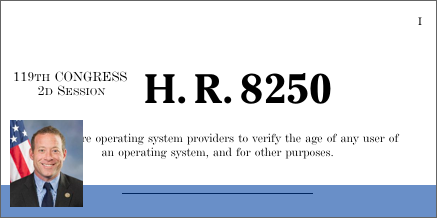
So, OS-level age-gating is going federal, which will effectively kill your rights to device ownership and what’s left of free speech and expression.
Enjoy your free speech while you still have it because this is a clear attempt to erase that right.
SOPA never died, it just went into hiding until time to reemerge, and now’s that time, this is basically SOPA in a save the kids trenchcoat.
Wouldn’t this just be unenforceable for any Linux distros not directly owned/maintained by a US-based corporation? I don’t really see how they could force a distro to comply, unless they start going after individual maintainers who live in the US.
If you read this
lawbill in the strictest way, it makes almost no sense. It says that anyone who makes or controls an operating system has to check the age of every person who uses it. But it does not limit this to big companies. That could mean volunteers who help build Debian or even someone at home making their own version of Linux. Thelawbill would expect them to build a system that asks for (and verifies) a birthday before you can use the computer.It gets even stranger with websites like GitHub. If someone downloads shared code and uses it, the person who posted it might be seen as responsible. But they have no way to know who downloaded it or what they did with it. The
lawbill would still expect their system to check ages and share that information with app makers.Gets even more absurd when you start to dig at the definition of an ‘operating system’.
Besides computers and phones, lots of small electronic devices have a rudimentary OS built into them, including (among many other things) a lot of appliances these days. Forget needing to verify your age in order to use your computer, say hello to needing to verify your age in order to use a refrigerator … or a gas pump.
I’d say the majority of equipment and devices in the POS sector of IT make this version of the bill wildly impractical and doomed from the start. They’ll either have to redraft it to specifically be about consumer devices or the retail, restaurant, and c-stores sectors will be up shits creek.
They have many ways to do this if they want:
Even if they don’t go after individuals they can do a lot of damage in restricting trade and business use of something. The mere threat of legal action is though to make business owners nope out.
It’s already risky to draw attention to yourself by using privacy focused phones when traveling. It’s the ultimate “if your have nothing to hide why are you worried” situation.
They’re forcing legitimate users to either give up or go underground and risk being seen as criminals.
Multiple forks of software go brrrrrrrrrrrrr
https://github.com/explainers-by-googlers/Web-Environment-Integrity
This was a proposal a few years ago for how to enforce “trusted web”. Basically, a way for service providers to verify, at a per request basis, that the client is using an unmodified software stack, starting with an operating system signed by a trusted developer. Could absolutely be modified to enforce this shit.