

cross-posted from: https://feddit.online/c/tech@piefed.world/p/2033724/motivated-reasoning-and-confirmation-bias-drive-viral-claims-of-russian-bot-declines
cross-posted from: https://feddit.online/c/tech@piefed.world/p/2033724/motivated-reasoning-and-confirmation-bias-drive-viral-claims-of-russian-bot-declines
This is probably a dumb thing to say:
if we could really trace that much bot traffic to 3-4 big data centers, surely we could have already cut it off by filtering a few addresses?
Now, the obvious counterpoint, what if Russia has some massive distributed private network to disguise where the traffic is coming from?
surely that network is designed so it could handle a couple of nodes (in this case Data Centers) going out without us noticing a drop? Say Russia has 15 DCs, if 4 go out we should still be seeing ~70% of bot traffic
Even a distributed botnet can be cut off with blocking a few control addresses.
Nope. It is trivial to set up a server to use a lot of IP adresses (think hundreds or thousands), and distribute them anong the bots.
You can lease IP addresses per month cheaply. Brokers supply you with the right ones so you appear to come from the country you claim if that is important. Usually it isn’t, as no one sees the IP except the platform, and they usually don’t care (nor should they really)
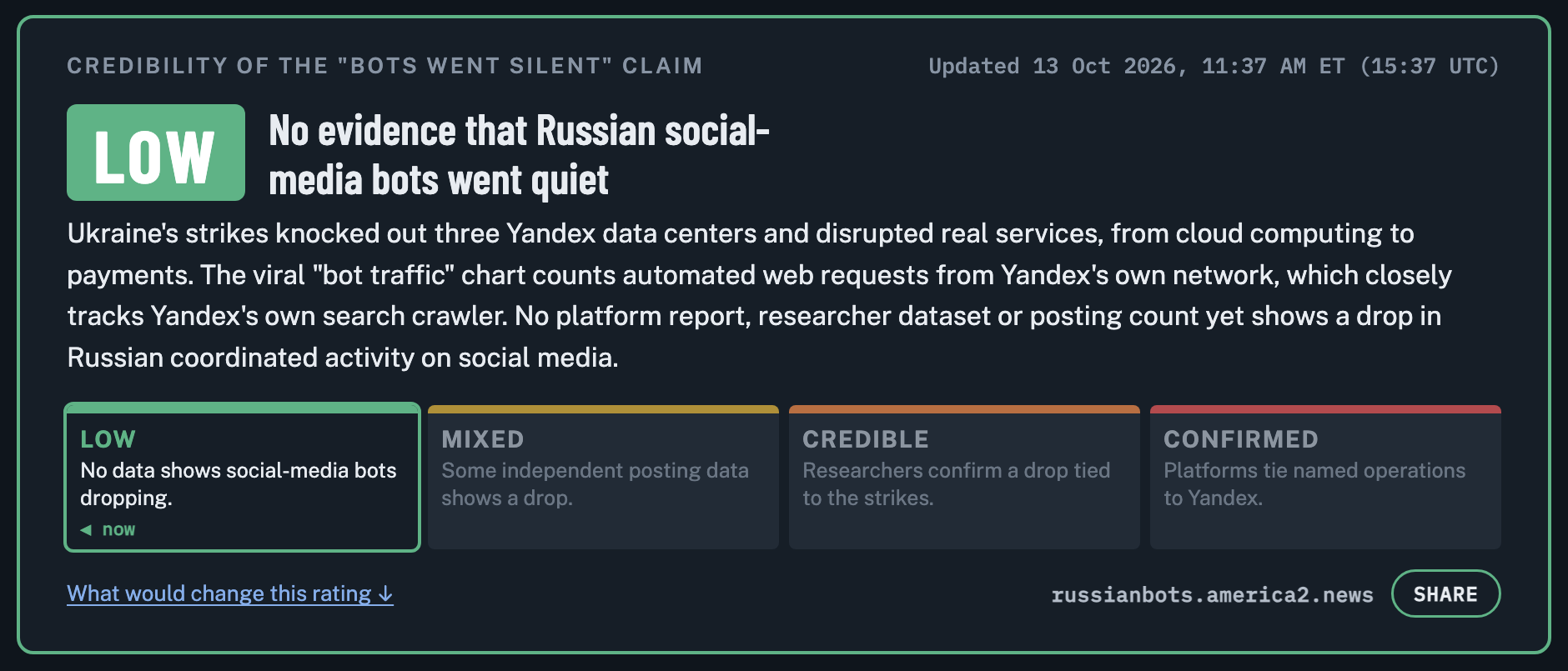
There was a story linked from hackernews yesterday that said Yandex has both a cloud and a search engine. The search engine bots, which are similar to google bots were knocked off line. Some Russian bots used the Yandex cloud and were knocked off line momentarily but quickly switched to other networks. In other words Russia uses redundancy like every other competent tech user…
I dont have rally any info or anything specific to say about the not situation, but I can tell you that systems like these have a tendency to fall like dominoes.
You see, often, these sites are relatively near current capacity with room for fail-over overhead from somewhere else. But, if you have a really big failure or multiple failures, things can go over capacity trying to cover for the stuff that went offline.
With networks and most things in the IT world, going over capacity often snowballs into a negative feedback loop, where the maxed out things are too slow, so things time-out, try again, people get impatient and press “refresh” 73 times, etc. This can multiply the already maxed out traffic, keeping things basically DDOSed for even days while it gets sorted out.
On top of that backups that people have set up are often poorly tested and dont actually work when its time to need them, like forgetting to replace the expired fire extinguishers.
Of course we could have. But Facebook and other platforms love it because it drives engagement. Bots inflate the user count, and bait posts get users arguing.